
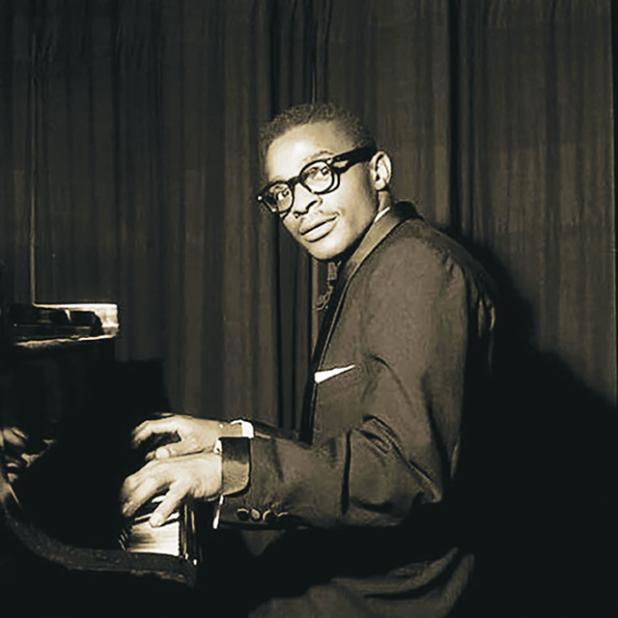
Striking the Right Note
Jazz commentator Scott Yanow referred to him as “one of the most technically skilled and brilliant pianists in jazz.” Leonard Feather, jazz journalist, producer, and songwriter, and author of The Encyclopedia of Jazz, once said of him “In his prime, he was one of the three greatest jazz pianists of all time.”
His story started here in Hardeman County.
Phineas Newborn Jr. was born December 14, 1931, in Whiteville, Tennessee. His father, Phineas Sr., and brother, Calvin, were also talented musicians playing the drums and guitar. Phineas, Sr. at one time owned a musical instrument store on Beale Street. Phineas Jr. would become proficient in piano, trumpet, and saxophone. He went to Booker T. Washington High School in Memphis during the day and played as a member of the house band at the Plantation Inn Club in West Memphis, Arkansas at night. The band included his father, brother, and future legendary producer Willie Mitchell. The group would work together as studio musicians with Sun Studio on some of the studio’s earliest recordings. Newborn studied music at both Tennessee Agricultural and Industrial College (today’s Tennessee State University) and at Lemoyne College in Memphis.
After serving in the United States Army, he returned to continue playing with his father’s group. In 1952 while playing at a club in Memphis, William “Count” Basie heard him play and brought him to the attention of legendary Columbia Records producer John Hammond, who had launched the careers of Basie, Benny Goodman, and Charlie Christian. Newborn moved to the east coast and began not only playing in clubs there but also began work on his first album. His recording of “Nostalgia in Times Square” was featured in John Cassavetes’ early film, Shadows. Newborn toured Europe as part of a production known as “Jazz From Carnegie Hall”.
In the early 1960s, he moved to Los Angeles and continued making records. Two of his most notable albums recorded during this time were A World of Piano and Together. Newborn was deeply affected by critics who felt his music style was too simple. Over time Newborn developed emotional problems and was admitted to Camarillo State Mental Hospital in California. After his time in the hospital, he returned to recording again in 1969. He recorded Please Send Me Someone To Love and Harlem Blues for Contemporary Records.
Newborn moved back to Memphis in 1971, but his first years back in Tennessee were not good for him. He was mugged and several of his fingers, a pianist’s most critical tools, were broken. After recovering from this incident he did return to playing but critics noted that he did not have the same brilliance as his earlier music. He performed again in New York in the late 1970s and earned favorable reviews from The New York Times. These, along with a resurgence of interest in his music, gave him the opportunity to perform at the Montreux International Jazz Festival in Switzerland, performing alongside of Jay McShann, Hank Jones, and John Lewis. He also played in a three-piano setting with Herbie Hancock and Chick Corea.
Newborn died in 1989 in Memphis after a bout with lung cancer. He had reportedly been working on a set of sonatas by Russian composer Alexander Scriabin. Despite his success in the music industry, Newborn was buried in a pauper’s grave in Memphis. Even though he endured a number of setbacks, many of his recordings, including The Great Jazz Piano of Phineas Newborn Jr. and Phineas’ Rainbow, continue to be highly regarded by jazz critics and commentators, calling him “one of the most technically skilled and brilliant pianists in jazz.”