
Ladybug, Ladybug fly away home
“Our Family Life Center is absolutely overrun with those little critters,” said one exasperated member of a local church. She was referring to an infestation of what many Hardeman Countians are calling “Japanese Beetles”. “There are swarms of them. We vacuum them up and the next day they’re back.”
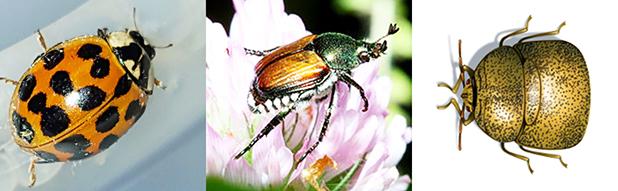
The Japanese Beetle was first discovered in the United States in 1916 in a nursery in New Jersey. It is thought the larvae entered in a shipment of iris bulbs. Since that time, according to Wikipedia, the beetle has spread extensively in states east of the Mississippi River. It isn’t a pest in Japan because it is controlled by natural predators. Unfortunately, in the U.S. it causes considerable destruction to over 200 species of plants ranging from grass to rose bushes to grape vines and peach trees. They gather in large numbers to feed on a plant until it’s basically skeletonized. Japanese Beetles are about a half inch long. They are metallic green in color and have tan wings. Thankfully these are not the insects blanketing Hardeman County.
Dr. Karen Vale is a Professor of Entomology and Interim Director of the UT Extension Institute of Agriculture. “What you have there could be an infestation of Kudzu Bugs. They were first discovered in the Atlanta, Georgia area in 2009 and have rapidly spread across the eastern, southeastern, and now into the mid-western United States. Strangely, these insects are both a blessing and a curse. They eat kudzu. That’s a blessing. They eat soybean and corn plants. That’s a curse. There are many different kinds of ‘lady beetles’. Sometimes they’re called stink bugs. Some are simply a nuisance. Others, like the Kudzu Bug are destructive pests,” said Vale.
To view more, please log in or subscribe to the digital edition.