
Ames Historical Society treated to tour of archaeological digs
Say “Ames Plantation” and most area residents immediately think of the National Championship for Bird Dogs. Not surprising since the trials are highly publicized and have been held at the plantation since 1915. There’s so much more. Prehistoric settlements on Ames Plantation? Yes there were. Historic sites? Yes there are. Ongoing agricultural, forestry, wildlife, and livestock research? Yes there is.
“From the Board of Trustees down to every person who works here, we consider ourselves stewards of the land. We owe it to the public to protect and preserve the cultural resources and the history found here,” said Jamie Evans, Research Associate and Assistant Director. One tool used in the preservation effort is the Ames Plantation Historical Society. The society’s over 200 members provide approximately 500 volunteer hours annually, assisting in various projects from cemetery cleanup to archive transcription.
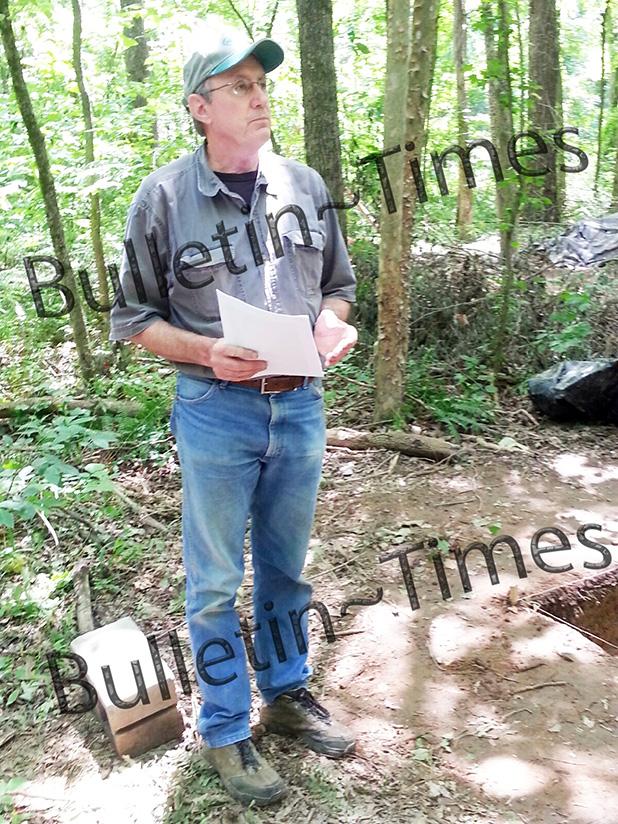
Members of the society were recently treated to tours of the prehistoric and historic archaeological digs currently underway at the Plantation. Dr. Andrew Mickelson, Professor of Archaeology at the University of Memphis, has been engaged in the prehistoric exploration for nine years and conducted that portion of the tour.
In a short lecture prior to visiting the dig, Dr. Mickelson provided guests information gleaned to date. Carbon dating of artifacts shows that Ames was the site of a Native American settlement between A.D.1100 and 1300. There are four mounds and remains of a few dozen houses. “The settlement was obviously hierarchical. It was a chiefdom,” Mickelson said. Ethnographic information shows the trial was male dominant but lineage was through the female.
Mickelson went on to say “They were civilized but not in the way we view civilization. They were a complicated people with skills in agriculture, science, astronomy, and engineering. Religious ceremonies were a part of the culture. They worshiped the sun and viewed fire as the sun on earth. The chief was a semi-god”.
They were skilled farmers. Corn, squash, and beans were their crops. Ingeniously, they planted the corn as a border around the fields. Squash was planted within and eliminated weeds. Beans were planted so that their vines could use the corn stalks as bean poles. “They had no domesticated animals. Protein was derived from the abundant wildlife and from fish caught in nearby waterways,” said Mickelson.
To view more, please log in or subscribe to the digital edition.