
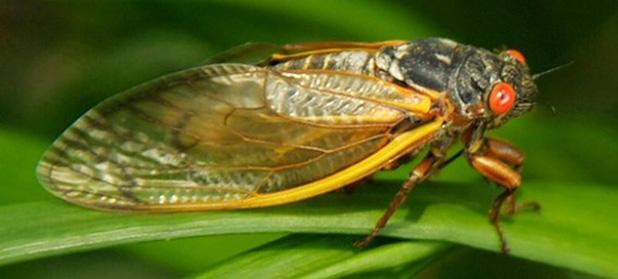
There’s millions of cicadas singing
There’s got to be millions of them all singing at the same time. They are cicadas, pronounced si-kay-das down South and si-kah-das up North. Not a single one is a locust. Many people call them locusts. They are not. Many people call them katydids. They are not. Cicadas, locusts, and katydids are three totally different insects.
Locusts look like grasshoppers. In fact they are actually members of the grasshopper family. They have been written about and feared since Biblical times because of their ability to destroy any and all vegetation in their path. Swarms of locusts still create havoc, particularly in some Middle Eastern countries. The katydid’s name represents the characteristic sound a male makes as he rubs his wings together to attract females. They, too, are members of the grasshopper family but have a completely different appearance. Katydids live in trees and their green, leaf shaped wings serve as camouflage. They feed on plant matter but are not destructive like their distant relatives, locusts. Some species are actually predatory, feeding on other insects. Cicadas, on the other hand are not members of the grasshopper family.
Local residents are currently being serenaded by what are known as “periodical cicadas”. According to the U.T. Extension Center, two races of periodical cicadas exist. One has a 17 year life cycle and is more common in the northeastern United States. The other has a 13 year life cycle and is distributed more throughout the southeast. Due to its location, both races occur in Hardeman County.
To view more, please log in or subscribe to the digital edition.